
Menhir Photonics Lasers Power ESA’s Deep-Space Ground Network
Menhir Photonics Lasers Power ESA’s Deep-Space Ground Network
 Photonics Toolbox
Ultra-stable frequency and timing, now in operational service across three continents
Every spacecraft that ESA tracks depends on a reference it rarely gets credit for: an ultra-stable clock signal, distributed reliably to every corner of a deep-space ground station. This week, a new generation of that infrastructure became operational across ESA’s ESTRACK network, and Menhir Photonics is proud to be part of it.
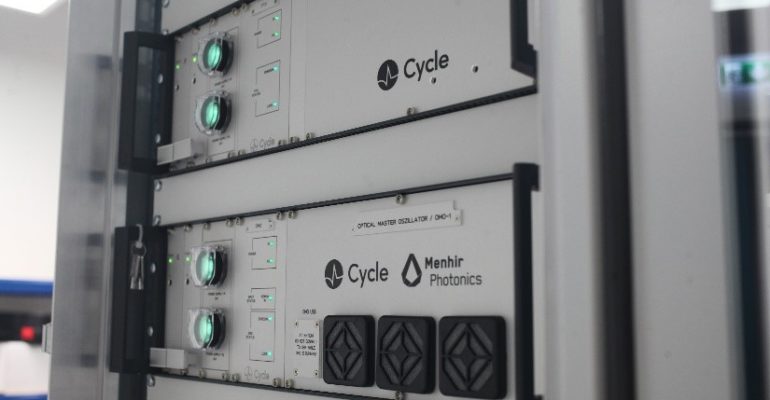
Cycle GmbH has deployed its 2nd Generation Frequency and Timing (F&T) system at three ESA deep-space ground stations: Cebreros in Spain, New Norcia in Australia, and Malargüe in Argentina. Developed in close collaboration with ESA, the system provides a common, high-performance synchronisation backbone for telemetry, tracking, command, and radio-science activities across the network.
The Heart of the System: Our Lasers
At the centre of Cycle’s fibre-optic distribution architecture are Optical Master Oscillators (OMOs), built around ultra-low-noise, long-lifetime mode-locked lasers developed by Menhir Photonics as a subcontractor to Cycle.
The laser’s repetition rate is phase-locked to the station’s prime active hydrogen maser. This generates an optical pulse train that transfers frequency and time over actively stabilised fibre links, allowing reference signals such as 10 MHz, 100 MHz, 1 PPS, and NTP to be delivered with ultra-low noise, even across complex station layouts and long distances.
“Reliable frequency and time distribution is a mission-critical function for deep-space ground stations,” says Florian Emaury, CEO and Co-Founder of Menhir Photonics. “Our lasers are designed for exactly this: long lifetimes, low noise, and stability that holds up in demanding real-world environments.”
Validated in Real Operations
The system was not only built but validated under real operating conditions. Following installation at each site, Cycle carried out end-to-end testing of the complete signal chain, from the hydrogen maser references through the optical links to the antenna equipment rooms. The measurements show performance more than an order of magnitude better than that of the prime clocks, with no measurable degradation of the signal.
Dr Kemal Shafak, Project Manager at Cycle GmbH, reflects on what that validation meant:
“As the new F&T system introduces cutting-edge optical technologies into the ground segment, on-site validation under real operational conditions was particularly critical. The successful commissioning shows that these emerging technologies can be reliably deployed in demanding deep-space operations.”
His colleague, Dr Michael Hagemann, Project Manager at Cycle GmbH, highlights the pace of the programme:
“Completing the deployment across three deep-space stations on different continents within such a short timeframe reflects both the maturity of the system and the close cooperation between ESA and Cycle.”
A Multi-Year Collaboration
The programme began in September 2020 and moved through three phases: development and validation at ESA’s Ground Station Reference Facility, implementation at the operational antennas, and finally commissioning at Malargüe in November 2025. Over roughly three years, the team delivered multi-rack systems, integrated frequency, timing, optical, and GNSS infrastructure, and supported each station through to operational service.
The system is also designed with the future in mind. While the current configuration distributes radio-frequency signals, the same optical technology provides a pathway towards optical clocks as primary references, as these move towards operational use.
Why It Matters
Deep-space tracking, navigation, and radio science all rely on timing that is stable over long periods. Menhir Photonics’ lasers are built for that kind of demanding, long-duration operation, and this deployment shows what that looks like in service.
We are grateful to Cycle GmbH for the collaboration, and to Dr Sinda Mejri and her colleagues at ESA’s ESOC for their guidance and support throughout the programme.
Read the full project story
Search
Popular posts
- Menhir Photonics Lasers Power ESA’s Deep-Space Ground Network
- Industrialising the Precision Backbone of Digital Infrastructure
- Menhir Photonics Sponsors the 2026 Siegman International School on Lasers
- Leading Through Growth: Florian Emaury on Menhir Photonics’ Strategic Vision and customer relationships
- From Physics to Finance: How Anna Pogrebna Financed the Scale-up Behind Menhir Photonics’ Success